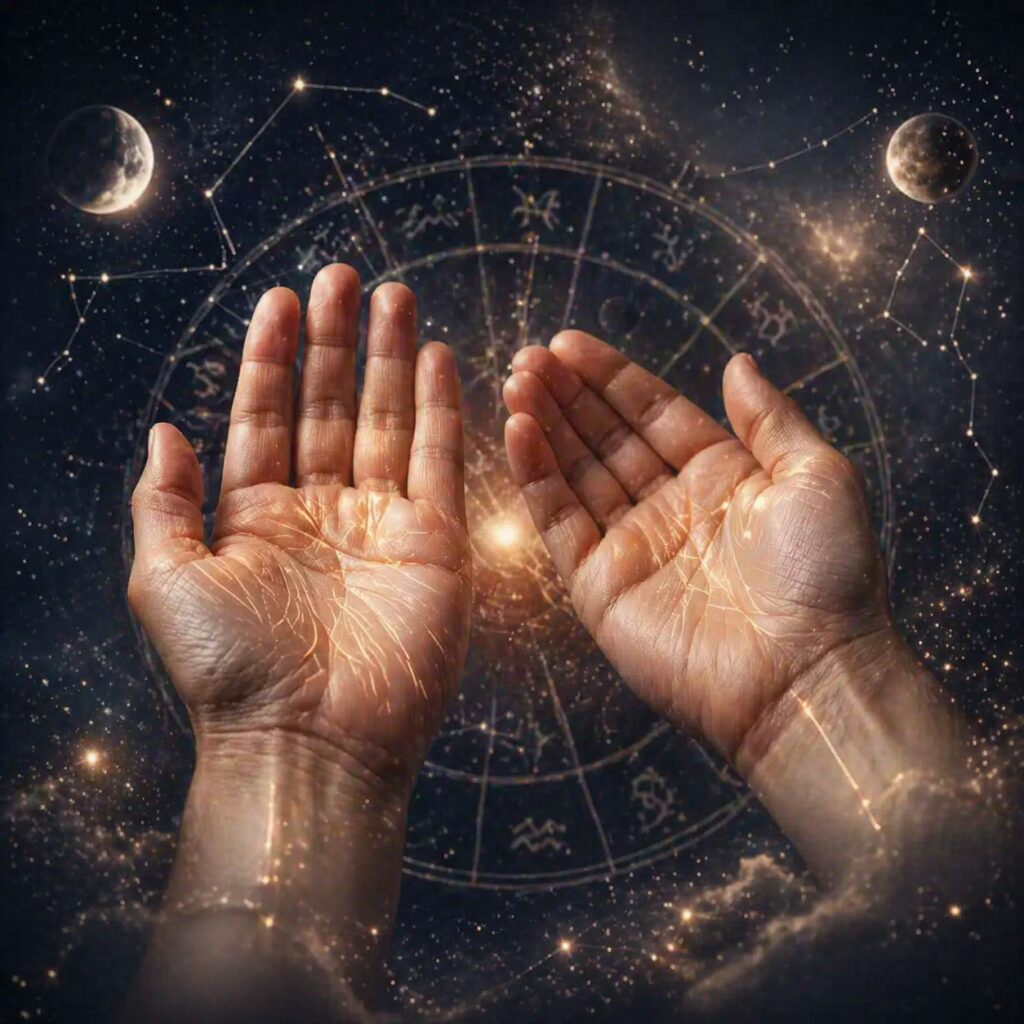

Left Hand Right Hand Palm Reading 2026: Which One Should You Use?
left hand right hand palm reading
🏮Table of Contents🏮
Introduction
It is one of the first questions anyone asks when they begin exploring palmistry: which hand do I read? The left or the right?
The answer depends on which tradition you follow — and the reasoning behind each approach reveals something profound about how different cultures understand the nature of destiny, free will, and the relationship between who we are born as and who we choose to become.
In this guide, we explore the Eastern and Western perspectives on left hand versus right hand palm reading, explain the classical rule that Master Soren follows in every reading, and help you understand what each hand reveals about your life — and why both matter.
The Short Answer: It Depends on Your Gender
In classical Eastern palmistry — the tradition rooted in Chinese texts including Ma Yi Xiang Fa, Liu Zhuang Xiang Fa, and Shui Jing Shen Xiang — the rule is straightforward:
Men read the left hand. Women read the right hand.
This is the traditional “Left for Men, Right for Women” principle that has guided Eastern palm readers for centuries. It is the rule that Master Soren applies in every reading at Prophecy Gifts, and the one we ask all clients to follow when submitting their palm photo.
But why? And what does the other hand reveal? The answer is more nuanced — and more fascinating — than the rule itself.
The Eastern Tradition: Left for Men, Right for Women
The Philosophical Foundation
In classical Chinese metaphysics, the left side of the body is associated with Yang energy — active, outward, masculine, and future-oriented. The right side is associated with Yin energy — receptive, inward, feminine, and connected to the past and present.
This is why, in the Eastern tradition, a man’s left hand is read as his primary hand: it carries the Yang energy that shapes his outward destiny, his career, his life direction, and the path he will forge through the world.
A woman’s right hand, by contrast, carries the Yin energy that reflects her inner world, her relationships, her emotional depth, and how she engages with the people and circumstances around her.
This is not a value judgment — it is a framework for understanding the different energetic channels through which destiny flows. In Eastern thought, both Yang and Yin are essential and equally powerful. The distinction simply points the reader toward the hand that most accurately reflects the individual’s life journey.
What the Non-Dominant Hand Reveals
In the Eastern tradition, the hand that is not the primary reading hand is still meaningful — it is simply read differently. For a man, the right hand reveals his innate potential, the character he was born with, and the tendencies that were present from birth. For a woman, the left hand holds a similar role.
Reading both hands together gives the most complete picture: the primary hand shows the life as it has unfolded and will continue to unfold; the secondary hand shows the raw material — the gifts, vulnerabilities, and tendencies the person came into the world with.
The Western Perspective: Dominant vs Non-Dominant
Western palmistry takes a different approach. Rather than assigning hands by gender, the Western tradition divides them by dominance:
The dominant hand (the one you write with) is read as the active hand — it reflects your life as it has been shaped by experience, choices, and environment. It shows who you have become.
The non-dominant hand is read as the passive hand — it reflects your natural disposition, the qualities you were born with, and the life you might have lived without external influence. It shows who you were born to be.
In this framework:
- If you are right-handed, your right hand is your active hand and your left is your passive hand
- If you are left-handed, the reverse applies
The Western approach places great emphasis on the contrast between the two hands. A significant difference between the lines on your dominant and non-dominant hands is seen as evidence of how much your life experiences have shaped and changed you from your original nature.
What Does Each Hand Reveal? A Comparison
Regardless of which tradition you follow, both hands carry distinct information. Here is how to think about the two hands:
The Hand That Shows Destiny and Direction
This is your primary reading hand — the left hand for men in Eastern tradition, the right for women; the dominant hand in Western tradition.
This hand reflects:
- The major life lines as they have developed through your experiences
- Your career trajectory and life direction
- How your relationships have actually played out
- The turning points and challenges your life has encountered
- Your current vitality and life force
This is the hand that changes and evolves over time. The lines deepen, branch, or fade in response to your life journey.
The Hand That Shows Innate Character
This is your secondary hand — the right hand for men in Eastern tradition, the left for women; the non-dominant hand in Western tradition.
This hand reflects:
- The personality and potential you were born with
- Natural talents that may or may not have been fully expressed
- Tendencies toward certain emotional patterns
- The blueprint of your life before experience shaped it
Comparing this hand to your primary hand reveals the gap — or harmony — between your innate nature and your lived experience.
Can Your Palm Lines Change Over Time?
Yes — and this is one of the most profound principles in Eastern palmistry.
Your palm lines are not fixed. They shift gradually over years and decades in response to your choices, experiences, emotional patterns, and inner development. A person who undergoes a significant life transformation — a major career change, recovery from illness, a deep spiritual shift — may notice measurable changes in their lines over a period of years.
This is why palmistry in the Eastern tradition is never understood as a fixed verdict. It is a map of tendency and potential, not a decree. The reading you receive today reflects where you are now and the direction you are currently travelling — not an unchangeable fate.
Master Soren reads the palm as a living document, always interpreted in the context of the whole hand, the mounts, and the overall shape and texture of the skin.
A Common Question: What If I Am Left-Handed?
In Eastern palmistry, handedness does not change the primary rule. A left-handed man still reads his left hand; a left-handed woman still reads her right hand. The rule is based on gender and energetic polarity, not on which hand you write with.
This is one of the key differences between Eastern and Western palmistry approaches. If you have always felt that your non-dominant hand holds more information about you, this may be worth exploring with a reader who can look at both.
In a full reading, Master Soren considers both hands — using the primary hand as the foundation and the secondary hand as context and comparison.
Which Hand to Upload for Your Free Palm Reading
When submitting your palm photo for a reading at Prophecy Gifts, please follow the Eastern tradition:
- If you are male: upload a clear photo of your left hand
- If you are female: upload a clear photo of your right hand
This ensures your reading is based on the hand that most accurately reflects your life path according to the classical Eastern tradition.
For the best results, make sure your hand is:
- Bare — no rings, bracelets, or watches
- Open and flat, palm facing the camera
- Photographed in natural light, without shadows
- In sharp focus so all lines are clearly visible
Free vs Full Reading: Understanding Your Hands in Depth
Start With the Free Reading
If you have never had your palm read before, our free palm reading online is the perfect starting point. Upload a photo of the correct hand (left for men, right for women), enter your email, and Master Soren will analyse your six core palm lines — Heart Line, Head Line, Life Line, Fate Line, Sun Line, and overall hand shape — delivering a personalised summary directly to your inbox.
The free reading is ideal for anyone who wants a clear, professional introduction to what their palm reveals without any commitment.
👉 Get Your Free Palm Reading Here →
Ready for the Complete Picture?
For those who want to go deeper, our Palmistry Chart Analysis by Master Soren covers both hands in a comprehensive 12-dimension analysis. This includes the Mercury Line, Marriage Line, Venus and Moon Mounts, Five-Element profile, finger and wrist line analysis, TCM health advisory, key life turning-point ages, and a personalised action guide.
Unlike the free reading, the Full Destiny Report examines the relationship between your two hands — comparing your innate character with your lived experience — to reveal the full story of who you are and where your path is leading.
This report is for those who are ready for genuine clarity: about their relationships, their career direction, their health, and the deeper patterns shaping their life.
👉 Unlock Your Full Destiny Report — $18.80 →
Frequently Asked Questions
Does it matter if I am left-handed? In Eastern palmistry, the primary reading hand is determined by gender, not by handedness. Men read the left hand and women read the right, regardless of which hand they write with.
What if I want both hands read? The Full Destiny Report by Master Soren considers both hands, using your primary hand as the foundation and your secondary hand as additional context. This gives the most complete and nuanced reading.
Can I send a photo of both hands for my free reading? The free reading focuses on your primary hand — left for men, right for women. For a reading that incorporates both hands, the Full Destiny Report is the appropriate option.
Why do some Western palm readers say to read the dominant hand? Western palmistry uses a different framework, based on handedness rather than gender. Both approaches are internally consistent — they simply reflect different philosophical traditions about how destiny and character are encoded in the body. Master Soren follows the Eastern tradition.
My two hands look very different. What does that mean? A significant difference between your two hands is considered meaningful in palmistry — it suggests that your life experiences have substantially shaped you away from your original nature, for better or for worse. This kind of contrast is particularly interesting to explore in a full reading.
Is the palm reading accurate if I upload the wrong hand? The reading will still reflect real patterns in your palm — but it may not align as precisely with your lived experience. For the most accurate reading, please follow the Eastern tradition: left hand for men, right hand for women.
Curious about what your palm reveals? Upload a photo of the correct hand and receive your free personalised reading below.